
Meet our newest neighbor in the galaxy - a black hole was discovered, and it is the closest one to our solar system yet! The exciting findings were published in a study in the journal Astronomy & Astrophysics, as recently as this Wednesday. The black hole is about 1,000 light-years away, and each light year is 5.9 trillion miles away (or 9.5 trillion kilometers). It may not sound all that close but in terms of the cosmos and even the galaxy, it’s considered practically next door according to European Southern Observatory astronomer Thomas Rivinius, who led the study.
For proportion, the black hole that was previously considered the closest one is about three times further - 3,200 light-years away. The black hole at the center of the Milky Way lies more than 25,000 light-years away, and another black hole which astronomers managed to capture in unprecedented detail in April last year is a whopping 55 million light-years away, in another galaxy altogether.
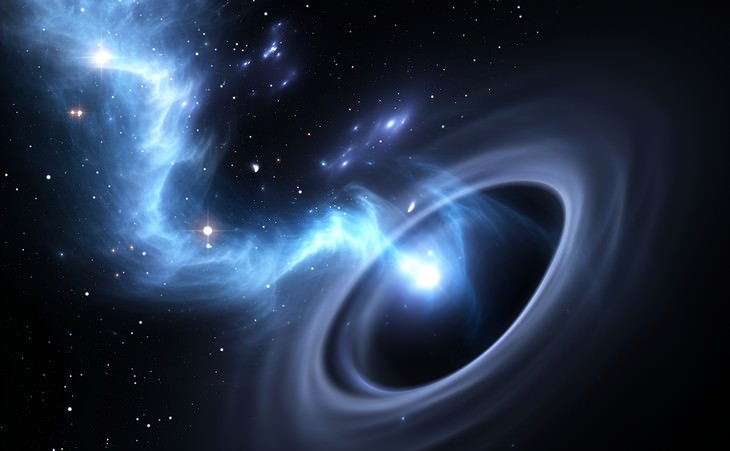
So if this newly discovered black hole is so close, how come it was wasn’t known to us until now? Black holes are regions in space that exert a force of gravity so strong that nothing can escape, not even light. Because no light is reflected, black holes are invisible, and the only way for astronomers to discover them is by noting the luminous bodies that orbit them. Most of the black holes we know of were detected because they were devouring nearby stars. Astronomers believe most black holes don’t have anything close enough to swallow, and so they remain undetected.
Related Article: 15 Pictures of Space From Different Observatories
Interestingly, this was exactly the case for the newly discovered back hole. It is a part of a two-star system called HR 6819, which has been examined by astronomers for years. When they analyzed the data, they noticed that there was something unusual about the behavior of the inner star of HR6819. Its velocity was so extreme, the team started suspecting that a third object existed in the system, which was flinging the inner star around.
They concluded it could only be a black hole. It was powerful enough to change the star's course, but not close enough to swallow it. “An invisible object with a mass at least 4 times that of the sun can only be a black hole," Rivinius explained in a press release.
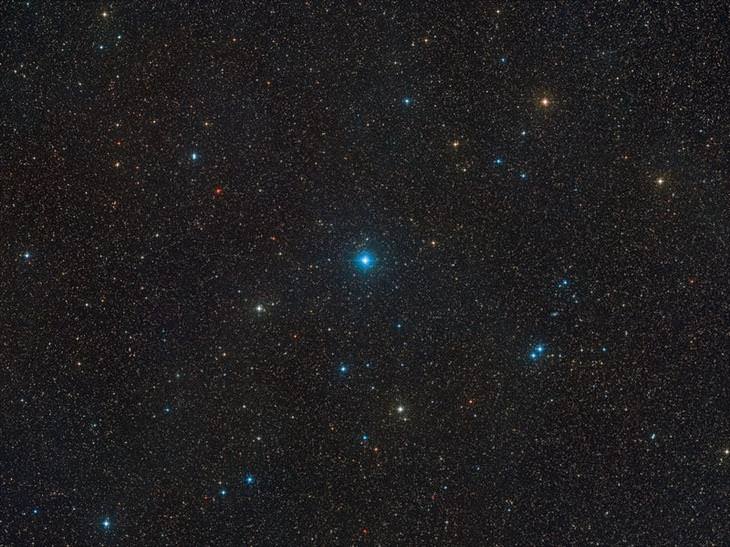
Another unusual aspect is that this star system is actually close enough for people in the southern hemisphere to actually be able to spot it on a clear night. This is the first-ever stellar system containing a black hole that can be seen with an unaided eye.
The video below shows what the astronomers saw: a star (blue) orbiting an invisible black hole (red), with another star (also blue) orbiting the inner pair. That makes this star system, called HR 6819, a triple system, and not double-system, as was believed thus far.
This discovery could help scientists progress and expand the knowledge of black holes immensely. "There must be hundreds of millions of black holes out there, but we know about only very few. Knowing what to look for should put us in a better position to find them," Rivinius said. Dietrich Baade, another astronomer on the research team called it “the tip of an exiting iceberg”.
The more we learn about the universe surrounding us, the more we realize how vast and mysterious it is, and despite being difficult, the process of studying it is certainly gratifying.

Take an Interactive Tour of Our Colossal Milky Way Galaxy
Fly Through the Milky Way Galaxy!
10:02
All the Fascinating Space Discoveries Made in 2019
2019 has seen quite a few eye-opening discoveries about space and astronomy. Learn about 26 of them in this video.
15:34
This Stunning Video Visualizes the Size of the Universe
This video visualizes the number of galaxies in the world, giving you a look into the true size of our enormous universe.
1:14:42
Documentary: How Did Our Universe Come From Nothing?
Can “nothing” truly become “something”? In this video, we’ll dig into this mind-bending question.
46:50
Deep Science: Why is Our Universe the Way It is?
Get ready to understand the Universe like never before...
2:17:01
Astronomy: What is Beyond the Edge of the Universe?
In this video, we explore what modern astronomy reveals about the universe’s boundaries—if they even exist.
2:17:01
Astronomy: What is Beyond the Edge of the Universe?
In this video, we explore what modern astronomy reveals about the universe’s boundaries—if they even exist.
20:32
History: Did the Trojan War REALLY Happen?
The Trojan War, the most famous of the ancient wars, fought by thousands of men for ten long years on the beaches of the famed city of Troy. Was all that real?
Has Modern Technology Changed Our Cognitive Abilities?
Modern digital technology is everywhere and it’s changing how we think, how we behave and even how we feel about things.
13:41
The 5 Most Important Fossil Discoveries from Last Year
2024 saw some really amazing fossil discoveries!
8:12
How Humans Helped Cats Take Over the World
The relationship between humans and cats goes back as far as 9,500 years. How did it al start? And how did humans help cats essentially take over the world?
8:46
Science: What is Reality? Dive in and Find Out!
What if everything you see, feel, and experience isn’t real? The simulation argument suggests that our reality might be nothing more than an advanced computer program.
10:46
Neat Life Hacks To Help You Remember Things Better
A lot of us tend to forget the simplest things at times. This video provides some neat tips to help boost your memory.
11:28
India Built a Monster Dam That Controls the Weather!
The Polavaram Dam doesn't just control floods - it moves water between regions and much more!
Hair Regeneration Could Be Possible With This New Process
Learn about an innovative new study which has revealed a novel treatment for effective hair regeneration.
50:02
Take a Trip Through the Universe and Witness its Beauty
Since its launch, the Hubble Telescope returned images of unprecedented beauty of a dynamic and changing universe. Take a look!
8:48
Fascinating: What Around Us is Invisible?
The Invisible Things that Turn the World...
9:34
Was Roman Concrete Really Superior to Our Own?
How did Ancient Romans make such durable concrete that it still lasts today?
Do You Have One Of These RARE Genetic Traits?
How unique are you? You might have several rare genetic traits that make you unlike most of the world's population!
Enjoy This Fascinating Collection of NASA's Best Photos
Here are 15 of NASA's most amazing recent pictures, along with brief explanations of exactly what is going on in each one.
Is Weekend Sleep as Good as Regular Sleep? Let's Check
If you thought sleeping in on the weekend was a bad habit, you're about to find out that it's quite the opposite.
Study: New Link Found Between Parkinson's and the Gut
A recent study has identified gut microbes likely involved and linked them to decreased riboflavin (vitamin B2) and biotin (vitamin B7), suggesting a potential treatment
3:55
50 Years Later, We're Debunking the Moon Landing "Hoax"
How do we prove to people the moon landing was real? By answering their doubtful questions in this video.
1:48
Boston Dynamic's Robot Does Some Incredible Things...
Boston Dynamics shows us again what her lead robot can do.
Chronically Late? What Science Has to Say About You
There are 8 positive things that science says about late people that we all need to know.
2:41
Trick-Mousing is Such Adorable Entertainment...
Mice are much cleverer than most people believe, and they easily respond to training, as long as you use positive reinforcement, or in other words - reward them frequently for their behavior with food.
These Underwater Craft Are Changing Marine Science
Here's a look at the most remarkable machines currently expanding our understanding of the underwater world.
34:33
Is China Number 1 in Global Technology?
In this video, we’ll take a closer look at the new developments hitting the market — and what they could mean for the future of transportation.
4:49
This Video Shows You a Different Way to Look at the World
You’ve heard of the fourth dimension but do you know what it is? This TED-Ed video helps uncover a bit of the mystery.
18:21
Fascinating: How Do Cats TRULY See Humans?
Understanding a cat's world is the key to strengthening your bond. Let's decode your cat's mind!
1:29
A Must See: White Cells Devouring Bad Bacteria!
A real look at how white cells identify and consume harmful bacteria.
8:12
The Tallest Statues Compared, Even Those Not Built Yet...
In this 3D animated size comparison, we showcase the tallest statues in the world alongside ambitious future projects.
12 Steps That Help to Explain Einstein's Famous Theory
Have you ever wondered what Einstein's Theory of Relativity is all about? If you have, here is an easy-to-understand explanation!
12:34
The World You See Doesn't Really Exist...
his video reveals how your brain constructs reality instead of simply perceiving it.
20 Peculiar Microscope Photos That You Really Must See
An unseen world exists at our fingers, and thanks to these wonderful micrographs, we can get a glimpse into that dimension.
I Bet You Didn't Have a Clue About These Human Body Facts!
The human body is the most complex machine known to mankind, but I bet you don't know these 10 amazing facts about it...
These 14 Forgotten Robots Promised So Much...
This collection showcases 14 cool vintage robots that were supposed to change everything.

5:47
This Genius Child is a Better Calculator than a Computer
This ‘human calculator’ could likely outpace you entering the numbers into a calculator.

11:15
These Paradoxes Continue to Mystify Scientists
Take a look at 7 scientific paradoxes that may never get solved.
Whoa! Who Knew the Human Body Was Capable of So Much?
Have a look at these 17 intriguing facts about the human body that we can practically guarantee will leave you in awe.
4:45
Woah! Learning to Play Music Has This Effect on Your Brain
Learning how to play an instrument can do wonders for our brain...here's how!
5:39
Why Are Your Ears Ringing? The Causes Explained
Nearly 15% of the human population worldwide are plagued by this strange sensation, but most people don't know the causes behind ringing in the ears...
7 Discoveries of Albert Einstein that Changed the World
The 7 biggest discoveries of Albert Einstein and how they changed the world forever.
14:58
Why IS Fentanyl So Dangerously Addictive?
In this video, we break down what opioids really do to your brain and body, what using them actually feels like, and why so many people are dying from Fentanyl overdoses.
8:10
Taller Doesn't Mean Bigger - the True Size of Skyscrapers
If you were to compare skyscrapers by area rather than height, which skyscraper would end up on top?
These Materials are Strange Enough to Boggle Your Mind...
There are some materials in this world that totally defy scientific convention. From metals that melt in your hand, to a solid lighter than air, take a look.
5:16
Fascinating: How Fast Does Our Brain Operate?
Ever wonder at what speeds our thoughts move?
To enable your Ad-Free Subscription, please fill the fields below
Your subscription was successful, now you can enjoy an ad-free experience!! Note: To make sure you get no ads, please make sure to log in to your account. If you are logged in already, then refresh the page. The subscription can be cancelled at any time.