
Although the founding of modern astronomy is often attributed to the great Greek scholars, Plato and Aristotle, European researchers now believe that humans that lived thousands of years earlier than they did already have a nuanced understanding of the stars.
The researchers studied cave drawings spanning Spain, France, Turkey, and Germany, and realized that what they were looking at was more than just mere depictions of nearby wildlife. It turns out that the bulls, rams, leopards, scorpions, and fish that they saw in the drawings are actually representations of constellations in the night sky.
Martin Sweatman and Alistair Coombs, from the Universities of Edinburgh and Kent respectively, published their findings in the Athens Journal of History last month. They undertook a chemical analysis of the paint used in the cave drawings and managed to date all of them back to between 12,000 and 40,000 years ago.
Furthermore, the researchers also used advanced software to calculate where the stars were positioned during the time that the cave drawings were drawn. To their astonishment, the researchers found that the cave drawings actually marked the dates of significant comet sightings, and were also correlated with star constellations visible at the time they were painted.
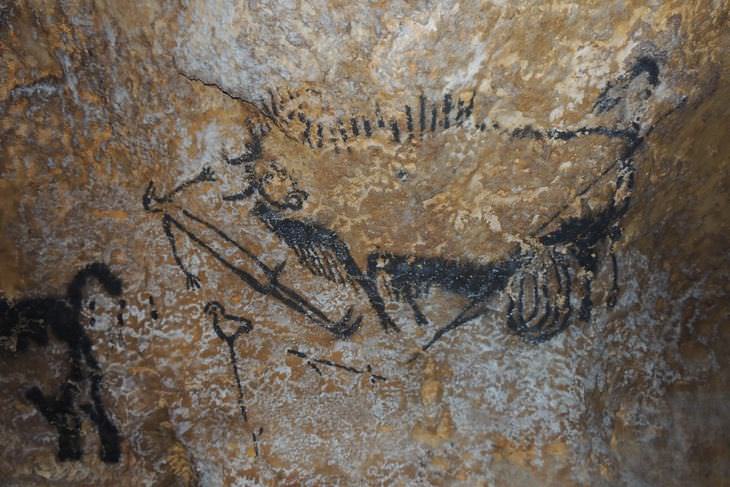
The world-famous Lascaux Shaft Scene, which was studied by the researchers, was found to depict a comet strike that occurred circa 15,200 BC. It’s hypothesized that the rhinoceros imagery contained in the painting signifies the constellation of Taurus, whereas the horse symbolizes the stars in the constellation of Leo.
Another finding that the researchers made was that a pillar in Gobeki Tepe, Turkey’s ancient archeological site, depicts a catastrophic comet strike that took place circa 11,000 BC. It features etched designs of a scorpion, bear, and bird, and the researchers were able to determine that the carvings represented the constellations that were in view at the time they were carved. More specifically, the carvings represented the Scorpius, Virgo and Pisces constellations.

As a result of all of the above, archeologists now believe that humans were keeping track of time via the stars up to 40,000 years ago. It’s also evident that ancient peoples had an understanding of the equinoxes, which occur due to the gradual shift of Earth’s rotational axis as it orbits the sun.
This notion disputes the fact that astronomer Hipparchus discovered equinoxes in 129 BC. "Early cave art shows that people had advanced knowledge of the night sky within the last ice age. Intellectually, they were hardly any different to us today," Sweatman said in a press release.
Many pieces of prehistoric art were cited in the study, not least the painting in Lascaux, France, but it also suggested that certain ancient relics were also used for recording time. For instance, The Lion-Man of Hohlenstein-Stadel Cave, the oldest known sculpture, dates back to 38,000 BCE. It is now believed to symbolize the star constellation Leo.


Depression Can Be Eased By Taking a Hot Bath, Study Finds
A small study conducted at the University of Freiburg has found that taking a daily bath might be good for depression. Read more about the study here.
Can Probiotics Improve Mental Health? Research Says YES
Studies repeatedly show that probiotics can be a potentially effective treatment for several mental health issues. This is what is currently known on the topic.
15 Beautiful Carl Sagan Quotes on the Stars and the Cosmos
A look at some profound quotes on the universe by famous astronomer and cosmologist Carl Sagan.
Study Reveals: Some Fireworks Release Dangerous Toxins
New study reveals that not all fireworks are properly tested for toxins. It doesn't mean you can't enjoy them, but be more cautious this 4th of July.
Forget Apples! It's an Egg a Day That Keeps the Doc Away...
According to new research, it could actually be an egg a day that keeps the doctor away.Find out more here!
Study Finds a Painless Way to Monitor Blood Sugar Levels
A new study found that continuous glucose monitors improve blood sugar control and quality of life in diabetes patients - pain-free.
5:14
Earth 2125: A Vision of the Future of Our Planet
Exploring what Earth could look like in 2125 reveals exciting potential.
3:39
Magic is Only A Vibration Away With This Great Experiment
All it takes is some sand, a metal plate and carefully toned vibrations from a speaker to create stunning and complex patterns. This video shows you the amazing results!
4:57
The First 3D-Printed Hotel is Already Being Built!
s evidence of this, a groundbreaking project is nearing completion, in which a hotel is being printed, and tourists will soon be able to visit it. Curious to see what it looks like?
Science Proves: These 10 Bible Stories Probably Did Happen
The Bible describes many seemingly supernatural cases, but today, science can show that they might have indeed happened.
14:34
What to Do (and Avoid) When Setting Up a Smart Home
Here's how you can set up a family-friendly smart home that will last long.
1:48
Boston Dynamic's Robot Does Some Incredible Things...
Boston Dynamics shows us again what her lead robot can do.
10:59
Fascinating Science: How Sand is Turned Into Glass
Have you ever looked through a window and wondered how it was made from simple beach sand? This video shows you that incredible process.
Science History: 17 Math Equations that Changed the World
In this article, we'll journey through 17 of these monumental formulas, demystifying the symbols to reveal the revolutionary ideas they contain and the immense impact they have had on the course of history.
22:35
Neuralink Update 2025: The Most Incredible Moments
Welcome to our 2025 Neuralink update, where we’ll take you through the most incredible and groundbreaking moments from the past year.
5:17
How Exactly Do We Hear? All is Revealed Here!
In this informative TED-Ed video, Douglas L. Oliver explains the complete science behind hearing.
Study: New Link Found Between Parkinson's and the Gut
A recent study has identified gut microbes likely involved and linked them to decreased riboflavin (vitamin B2) and biotin (vitamin B7), suggesting a potential treatment
6:05
The Real Reason Companies Prevent You from Fixing Things
Ever felt like you should be able to fix that broken gadget, but something's holding you back? Watch this to know more.
5 Puzzling Mysteries That Science Finally Managed to Solve
These weird occurrences have puzzled humanity for decades, if not centuries. Finally, scientists solved them & the solutions are exciting...
16 Interesting Things We Bet You've Never Seen Before
Once we have finished school and learned all the necessary skills at work, it may seem that no further studying is necessary. 16 interesting photos you wish you had seen in textbooks at school.
16:31
Why Building a Perpetual Motion Machine Is Impossible
Since the Middle Ages, scholars have been trying to build the mythical perpetual motion machine. Was it all in vain? Is it even possible to build such a machine?
NVIDIA CEO Reveals Which Degree Is Worth Studying
Electrical Engineering, Computer Science, or Physics? Nvidia's CEO has a surprising answer to which area should be studied nowdays.
10:11
10 Smart Home Gadgets You Didn’t Know You Needed
If you’ve ever wanted a smarter, more efficient home, these 10 gadgets might be exactly what you need.
8:19
You Won't Believe What Passes for a Phone in North Korea
You won't believe what phones look like in North Korea!
8:10
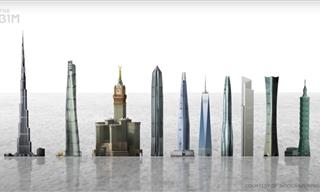
Taller Doesn't Mean Bigger - the True Size of Skyscrapers
If you were to compare skyscrapers by area rather than height, which skyscraper would end up on top?
56:12
What's the Largest Thing in the Universe?
In this video, we look into some of the mightiest structures in the known universe.
21:24
James Webb Telescope: Redefining Our View of Space
Here's a brief look at all the amazing discoveries made by the James Webb Space Telescope so far.
2:41
Trick-Mousing is Such Adorable Entertainment...
Mice are much cleverer than most people believe, and they easily respond to training, as long as you use positive reinforcement, or in other words - reward them frequently for their behavior with food.
7:21
Science: 20 Mechanical Principles Demonstrated Using Lego
In this video, we'll explore a variety of fascinating mechanical mechanisms, all demonstrated using Lego models.
These Materials are Strange Enough to Boggle Your Mind...
There are some materials in this world that totally defy scientific convention. From metals that melt in your hand, to a solid lighter than air, take a look.
2:17:01
Astronomy: What is Beyond the Edge of the Universe?
In this video, we explore what modern astronomy reveals about the universe’s boundaries—if they even exist.
Hubble Telescope: 35 Years of Incredible Photos
Exploring 35 years of reality-changing, universe-enhancing photos that opened the sights of outer space to us all.
15:41
Keep Your Home Safe with These Handy Gadgets
These 13 devices will transform your home security.
8:46
Science: What is Reality? Dive in and Find Out!
What if everything you see, feel, and experience isn’t real? The simulation argument suggests that our reality might be nothing more than an advanced computer program.
21:25
How Every Nuclear Power Got Its Atomics
This video will explain how each nation earned the complex and controversial title of nuclear power.
Has Modern Technology Changed Our Cognitive Abilities?
Modern digital technology is everywhere and it’s changing how we think, how we behave and even how we feel about things.
9:13
Want to Travel Quickly Through Space? Try Using a Wormhole
If you want to know what a wormhole is and how it is supposed to work, then you've come to the right place!
11:05
Science: Can AI Preserve Our Most Precious Memories?
Technologist Pau Aleikum Garcia talks about synthetic memories.
7:56
These 6 Chemical Reactions Changed the Course of History
Although we rarely pay much attention to the chemistry that constantly surrounds us, these 6 reactions changed history.
4:57
Fascinating: How Does Our Digestive System Work?
This video explains how the human digestive system does its daily.
Will We Ever Solve Our Universe's Most Complex Mysteries?
Here are 8 of the biggest unsolved mysteries from the world of physics.
36:24
Ever Wonder How a Steel Locomotor Works?
Let’s take a closer look at the engineering behind these compact workhorses.
14:58
Why IS Fentanyl So Dangerously Addictive?
In this video, we break down what opioids really do to your brain and body, what using them actually feels like, and why so many people are dying from Fentanyl overdoses.
11:28
India Built a Monster Dam That Controls the Weather!
The Polavaram Dam doesn't just control floods - it moves water between regions and much more!
Is Weekend Sleep as Good as Regular Sleep? Let's Check
If you thought sleeping in on the weekend was a bad habit, you're about to find out that it's quite the opposite.
Study Says: With Age, Come Certain Cognitive Abilities
a study published in August 2021 in the journal *Nature Human Behavior reveals surprising findings that challenge this assumption and may be of great interest to all of us.
9:54
Neo: The New Tele-Robot that "Cleans" Your Home
Neo is a new robot that has great capabilities and is designed to clean your home. Sounds perfect right? Well, there's a catch.
To enable your Ad-Free Subscription, please fill the fields below
Your subscription was successful, now you can enjoy an ad-free experience!! Note: To make sure you get no ads, please make sure to log in to your account. If you are logged in already, then refresh the page. The subscription can be cancelled at any time.